Tea growers often speak about their land the way winemakers speak about vineyards. The Chinese have an old phrase for it — tea from high mountains, wrapped in cloud and mist, tastes best — and modern plant science largely agrees. Cooler temperatures slow the growth of the bush, concentrating aromatic compounds and amino acids. Frequent mist filters harsh sunlight, which helps preserve the savoury L-theanine that gives some teas their sweetness. Rainfall, soil minerals and the angle of a slope all play their part. When you taste a tea, you are tasting a season in a particular place.
This page is organised by sub-region rather than by famous name. That is deliberate: the same style of tea can taste very different depending on where it grows, and a single region often produces several styles.
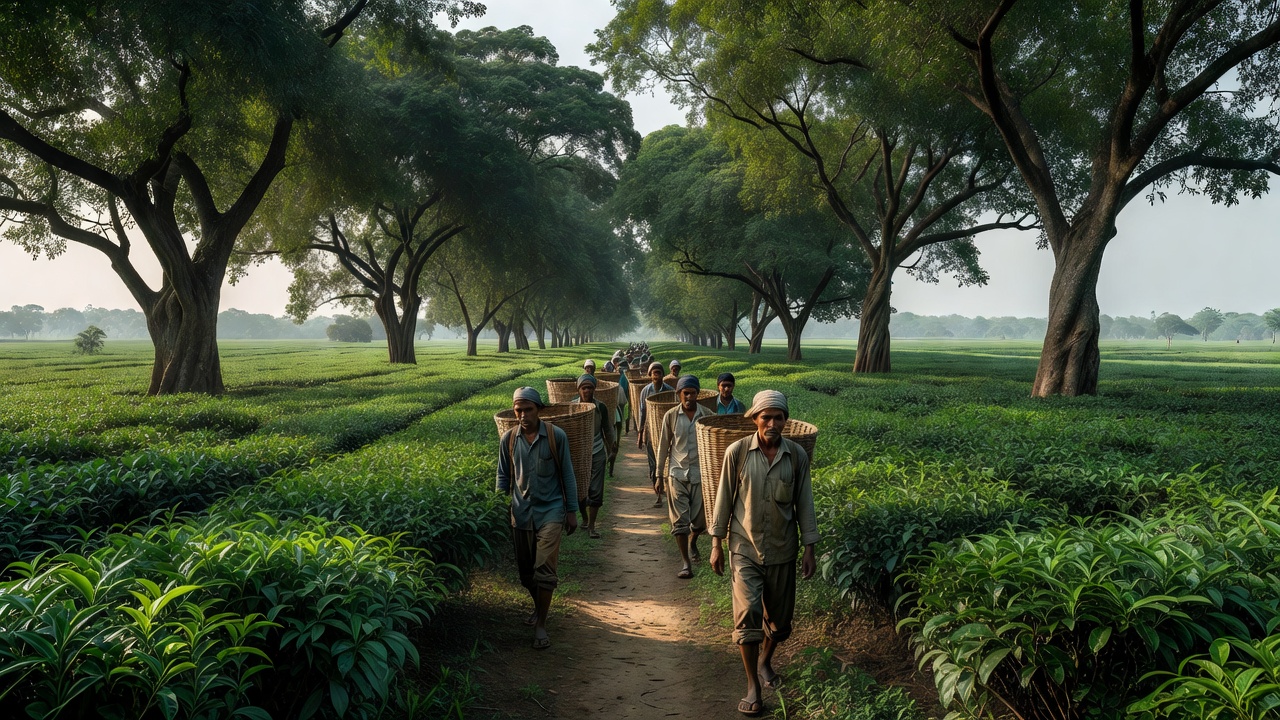
South Asia: Himalaya, plains and island hills
Darjeeling, in the Indian state of West Bengal, grows tea on steep slopes in the Himalayan foothills. Its harvests are described in "flushes". The first flush, plucked in early spring, is light, green-edged and floral. The second flush, in early summer, develops the deeper, grape-like note tea tasters call muscatel. Estates such as Happy Valley, close to Darjeeling town, open their factories to visitors during the season.
Assam lies a world away, on the hot, wet plain of the Brahmaputra River. Here the large-leaved assamica variety, native to the region, produces strong, malty black teas that stand up to milk — the backbone of many breakfast blends and of Indian chai. Further south, the Nilgiri hills of Tamil Nadu produce fragrant, smooth teas that are frequently grown year-round.
In Sri Lanka, teas are often classified by elevation. High-grown teas from Nuwara Eliya and Dimbula are bright and brisk; Uva, on the eastern slopes, is known for a distinctive seasonal character when dry winds blow in mid-year; low-grown teas from the south are fuller and darker. Tea arrived as a plantation crop in the nineteenth century after coffee rust devastated the island's coffee estates, and the hill country's landscapes — and its Tamil plantation communities — still carry that history.
East Asia: mist, rock and shade
Hangzhou & West Lake
Longjing, or Dragon Well, is a pan-fired green tea with a flat leaf and chestnut-sweet flavour, grown in villages such as Meijiawu and Longjing around West Lake.
Wuyi & Anxi, Fujian
Wuyi's rock oolongs grow among cliffs and gullies; Anxi is home to Tieguanyin, often lightly oxidised and intensely floral.
Yunnan
Ancient broad-leaf trees in Xishuangbanna and Lincang supply pu'er, a tea category that can be aged for years.
Alishan & Lugu
High-mountain oolongs from Alishan are creamy and floral; Dong Ding from Lugu, Nantou, is traditionally roasted for warmth.
Japan grows mostly green tea, steamed rather than pan-fired, giving a fresher, more vegetal profile. Uji, south of Kyoto, has cultivated tea since the medieval period and is famous for shading techniques: covering bushes for several weeks before harvest raises amino acids and lowers bitterness, producing gyokuro and tencha, the leaf stone-ground into matcha. Shizuoka, within sight of Mount Fuji, is the country's largest producing prefecture, while Kagoshima in the south harvests early and abundantly.
Korea's tea culture is closely tied to Buddhist temples. The terraced plantations of Boseong are the most visited, while the Hadong area near Ssanggyesa Temple in the Jirisan foothills is often linked with some of the country's earliest tea cultivation. Korean green teas are graded by plucking date, with the earliest spring leaf, ujeon, picked before the solar term Gogu in April.
Southeast Asia and beyond
Malaysia's Cameron Highlands were developed for tea in the colonial era; the BOH estates there are among the best-known places to see rolling fields up close. In northern Thailand, Mae Salong (Santikhiri) grows oolongs introduced by settlers with ties to Yunnan and Taiwan, while hill communities in the region also harvest from older, wilder trees. Vietnam's Thái Nguyên province is renowned at home for its tightly curled green tea, and in the northern mountains of Hà Giang, old Shan tuyết trees grow at altitude.
At the far western edge of Asia, the rainy Black Sea slopes around Rize in Türkiye supply the black tea poured in tulip glasses across the country.
Reading a landscape in the cup
A few general patterns hold almost everywhere and are worth carrying on your travels. Higher, cooler gardens usually yield lighter, more aromatic teas; lowland gardens tend toward body and strength. Spring leaf is generally more delicate than summer leaf. Shade boosts savoury depth. Mineral, rocky soils are often linked to a lingering, stony finish. None of these are rules, but they give you useful questions to ask a grower — and growers are almost always pleased to talk about their land.