Brewing traditions

Small gestures, different cups

Water temperature, leaf quantity, vessel and timing — each culture balances them differently, and each balance reveals a different side of the leaf.

Brewing is where a tea maker's work is either honoured or lost. The leaf in your bag has already been through withering, rolling, oxidation and drying; your part is to release what is stored inside it. Across Asia, communities have settled on very different ways to do that. Some favour many short infusions that let you follow a tea as it changes; others prefer a single, carefully prepared bowl; still others simmer tea with milk and spice into something new. None is more "authentic" than another. They answer different questions.

Below, each tradition is presented as a sequence you can try at home, followed by notes on what is local custom and what is broadly useful advice.

General principles that travel well

A few pieces of advice apply almost everywhere. Use fresh, soft-to-moderate water; very hard water dulls aroma. Delicate greens and white teas prefer water below boiling, roughly 70–85 °C, while black, roasted oolong and dark teas usually take water close to the boil. More leaf with shorter steeps tends to give vivid, layered flavour; less leaf with longer steeps gives a rounder but flatter cup. Pre-warming your vessel keeps the temperature stable. Everything else is custom.

Side by side

Many infusions, one bowl

China · Taiwan

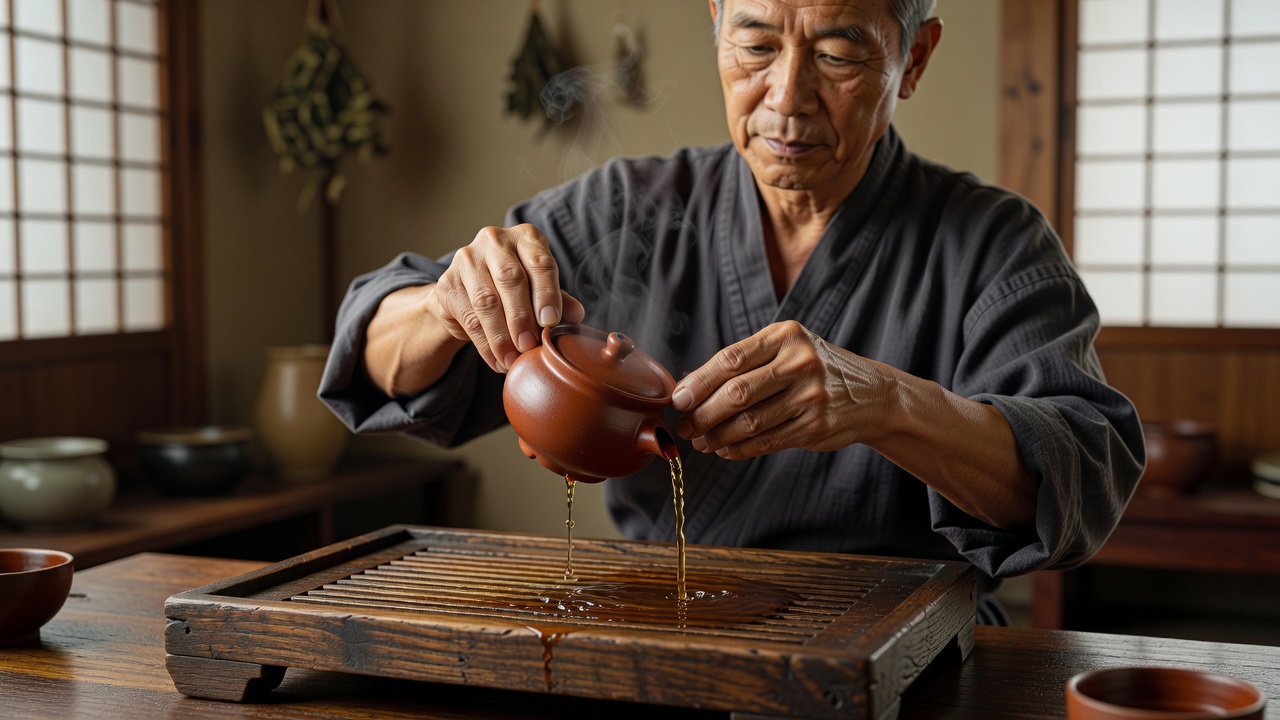
Gongfu cha — "tea made with skill"

Associated with Chaozhou in Guangdong and with Fujian, now practised widely in Taiwan. Small Yixing clay pots or porcelain gaiwans concentrate the brew.

  1. Heat water to just below boiling for rolled oolong.
  2. Warm the pot and cups; discard the water.
  3. Add enough leaf to cover the base generously.
  4. Rinse for a few seconds and pour away.
  5. Steep 10–20 seconds; decant into a fairness pitcher (gong dao bei) so every cup is equal.
  6. Continue for six to ten rounds, adding a few seconds each time.
Japan

Sencha in a kyusu

The side-handled kyusu pot is designed for one-handed pouring and has a fine built-in strainer for small steamed leaves.

  1. Boil water, then cool it to about 70–80 °C by pouring between cups.
  2. Place around 4–5 g of leaf in the kyusu.
  3. Steep about one minute — less for deep-steamed fukamushi sencha.
  4. Pour in turns across cups, a little at a time, for even strength.
  5. Shake out the final drops; they are the most concentrated.
  6. Re-steep briefly with slightly hotter water.

Ceremony and contemplation

Japanese chanoyu, the way of tea, centres on matcha whisked in a bowl. Its aesthetic was shaped by the sixteenth-century master Sen no Rikyū, who emphasised simplicity, rustic beauty and the idea of each meeting as unrepeatable. Formal ceremonies follow precise choreography, but you need not memorise it as a guest: your host will guide you. Bowing slightly, turning the bowl so you do not drink from its "front", and expressing appreciation for the utensils are customs of the tea room, not daily Japanese life.

Korean darye, literally "tea etiquette", is quieter and often linked to Buddhist temple practice and the scholar Cho-ui, who wrote about tea in the nineteenth century. Green tea is brewed in a small pot, poured into a cooling bowl (sukwu) to lower the temperature, then served in small cups. Temple stays in Korea sometimes include a darye session where the emphasis is calm attention rather than performance.

Tea transformed: milk, spice and the double kettle

India

Masala chai

  1. Simmer water with crushed ginger, cardamom and other spices.
  2. Add strong CTC Assam tea and boil briefly.
  3. Pour in milk and sugar; bring back to a rolling rise.
  4. Strain into cups — or, at a station stall, a clay kulhad.
Türkiye

Çay from a çaydanlık

  1. Boil water in the lower kettle.
  2. Steep Rize black tea in the upper pot over the steam.
  3. Pour concentrate into a tulip glass, then dilute with hot water.
  4. Choose your strength: dark (koyu) or light (açık).

In Hong Kong, "silk-stocking" milk tea — named for the fine cloth filter whose stain resembles hosiery — blends several black teas, pulls them repeatedly through the filter and finishes them with evaporated milk. It is a legacy of British colonial tea culture reimagined in the city's cha chaan teng diners. In Malaysia and Singapore, teh tarik is "pulled" between two vessels to create a frothy top.

These drinks remind us that tradition is living. A chai-wallah at a railway platform and a tea master in Uji are both experts working with the same plant.

Next: tasting vocabularyFind your tea trail