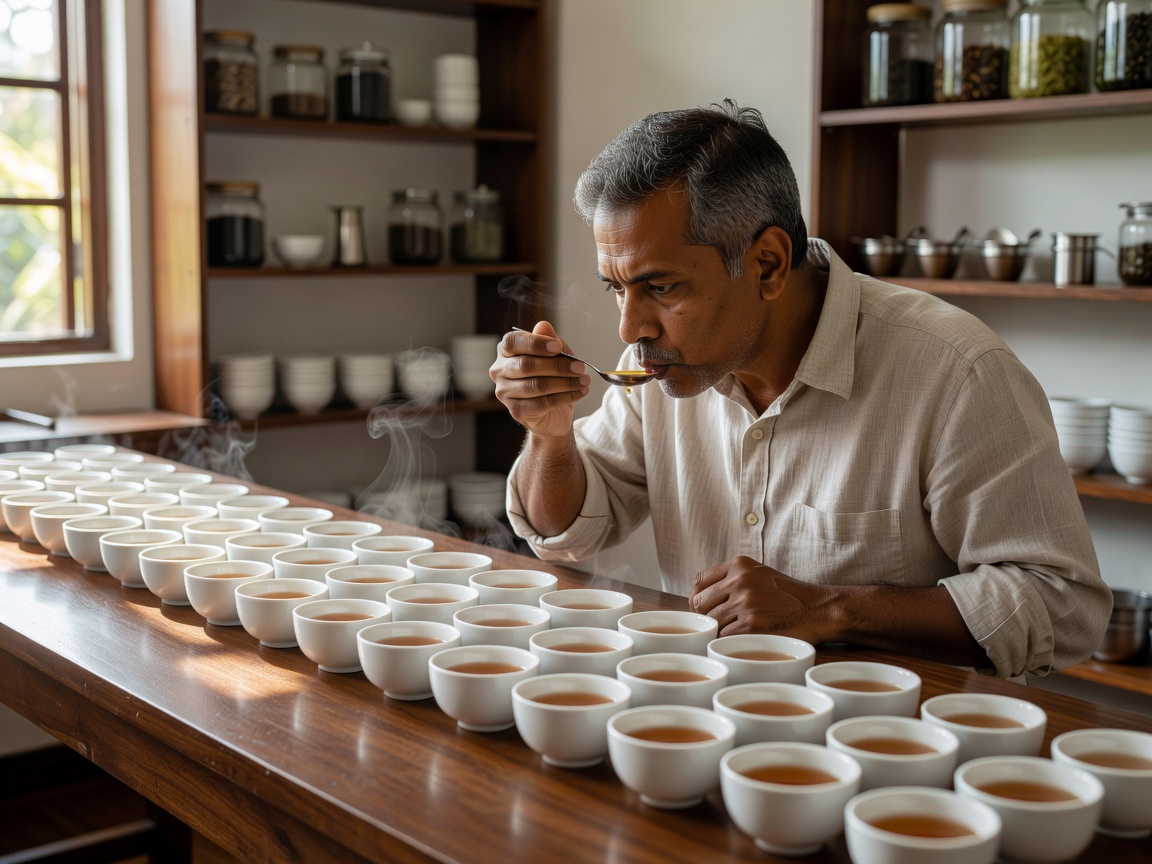
Tasting tea well has little to do with having a "good palate". It is mostly a matter of slowing down and having words ready. Professional tasters in Kolkata, Colombo and Hangzhou use standardised sets of white porcelain cups and lidded bowls so that every sample is brewed alike; you can borrow their discipline with nothing more than two identical cups and a timer.
The vocabulary below draws on several traditions. Some terms, like brisk or malty, come from the English-language tea trade. Others, like hui gan or yan yun, are Chinese concepts that do not translate neatly; we give their literal meaning and how tasters use them, without pretending they are mystical.
The six families, briefly
Processing, especially oxidation, defines the main categories. Green tea is heated soon after plucking to stop oxidation — pan-fired in much of China, steamed in Japan. White tea, associated with Fuding in Fujian, is simply withered and dried. Yellow tea adds a gentle "sealed yellowing" step. Oolong is partially oxidised, anywhere from lightly to heavily, and often roasted. Black tea — called hong cha, "red tea", in Chinese for the colour of its liquor — is fully oxidised. Dark teas such as pu'er undergo microbial fermentation, either slowly with age or accelerated in the "ripe" method.